What Is Shaft Type? A Guide for Kayak Paddles Buyers (2026)
As an Amazon Associate we earn from qualifying purchases. Links on this page are affiliate links.
Shaft Type Explained For Buyers
Shaft type explained reveals how the paddle connects to your stroke efficiency. You choose between straight shaft and bent shaft designs. This choice affects your comfort and power transfer. The distinction is clear in product listings. You see these options listed under paddle specifications.
A straight shaft paddle has a uniform cylinder from one end to the other. The diameter remains constant. This design is simple and robust. It works well for casual paddling. You get a reliable tool for general use. The straight shaft is easy to manufacture. It is also easier to repair if damaged. Most beginners start with this option. It offers a neutral feel in your hands.
A bent shaft paddle has an angled section near the blade. The angle is typically around seven degrees. This bend aligns your wrist with the blade entry. It reduces strain on your wrists and forearms. You may feel less fatigue on long trips. The bent shaft promotes a more efficient stroke. It is preferred by some experienced paddlers. The design focuses on biomechanical alignment. You notice the difference in your joint comfort.
When shopping, check the product details for these terms. Look for straight shaft or bent shaft in the description. Some listings may use technical terms like feather angle. That is a different spec. Stick to the shaft shape category. You want to match your body mechanics. If you have wrist issues, the bent shaft might help. If you want simplicity, the straight shaft is fine. Your choice depends on your paddling style. Consider how you hold the paddle. Think about your typical trip length. The right shaft type supports your goals. It makes every stroke count. Read the specs carefully before buying. Ensure the description matches your needs. This small detail impacts your time on the water. Choose wisely for better enjoyment.
Straight Shaft Versus Bent Shaft
Straight Shaft
A straight shaft offers a uniform diameter from grip to blade. This design simplifies the stroke mechanics. You do not need to adjust your wrist angle for each side. Werner offers this style in models like the Skagit FG. It weighs 3.13 pounds and measures 240 cm. This type suits general touring and stable forward paddling. You get consistent power transfer without specialized ergonomics. The trade-off is less wrist relief over long distances. It is a practical entry-level option for most kayakers. You prioritize durability and ease of use here.
Bent Shaft
A bent shaft angles the blade relative to the shaft. This geometry matches the natural arc of your stroke. It reduces wrist strain during repetitive paddling. Bending Branches provides this in wood for canoeing. Werner also offers fiberglass bent shafts for touring. The Camano 240 Bent Shaft weighs 1.81 pounds. It fits paddlers who benefit from ergonomic efficiency. You see better water catch and reduced fatigue. The trade-off is a learning curve for the new stroke path. It is less intuitive for beginners. You choose this for comfort and specialized power application.
Is This Spec Worth Your Time
Who needs it
You should prioritize shaft type if you paddle for many hours daily or compete in races. Bent shafts are designed to improve power transfer and reduce wrist strain. The angled blade matches your natural stroke arc, allowing for a more efficient catch. If you notice wrist fatigue or shoulder pain after long sessions, this geometry may help. It is also critical for sprinters who need maximum energy return with every pull. Straight shafts require a neutral wrist position, which can feel restrictive during high-intensity paddling. If you value biomechanical efficiency and are willing to adapt your technique, the bent shaft offers a tangible performance advantage. You will feel the difference in how the blade enters the water and how power moves through your stroke.
Who can skip it
You can ignore shaft type if you paddle casually for short distances or enjoy relaxed touring. Straight shafts are versatile and easier to learn. They work well for beginners who are still mastering basic stroke mechanics. If you switch between different kayak types or frequently change your paddling style, a straight shaft provides consistency. Bent shafts require a specific technique to be effective. If you do not have the time to adjust your wrist angle, the straight design is more forgiving. Prioritize blade size and material instead. These factors have a bigger impact on stability and weight. For recreational use, the comfort difference is minimal. You will not notice the power transfer benefits on slow, leisurely trips. Stick with the simpler, more adaptable option.
Shaft Type Glossary
Straight shaft
A paddle shaft with a uniform diameter from the grip to the blade. This design offers a consistent feel and simplifies stroke mechanics for most recreational paddlers.
Bent shaft
A shaft where the blade is angled relative to the grip. This design matches the natural arc of your stroke, potentially improving power transfer and reducing wrist strain during long sessions.
Stroke arc
The natural curved path your hand and paddle follow through the water. Bent shafts are engineered to align with this arc, optimizing the angle of entry and exit for each stroke.
Power transfer
How efficiently your physical effort moves the kayak forward. A well-matched shaft type reduces energy waste by ensuring the blade catches water effectively at the optimal angle throughout your stroke.
Wrist strain
Discomfort or stress in the wrist joints caused by repetitive paddling. Bent shafts can mitigate this by allowing a more natural wrist position, which is beneficial for competitive racers or long-distance paddlers.
Stroke mechanics
The physical technique and body movements involved in paddling. Straight shafts simplify these mechanics by requiring no adjustment to wrist angle, making them easier to learn and consistent for beginners.
Quick picks
| # | Product | Best for | Price |
|---|---|---|---|
| 1 | Werner Skagit FG 2-Piece Straight Shaft Paddle | General touring and stable forward paddling | Check price of Werner Skagit FG 2-Piece Straight Shaft Paddle on Amazon |
| 2 | Bending Branches BB Special Bent Shaft Wood Paddle | recreational canoeing on calm water | Check price of Bending Branches BB Special Bent Shaft Wood Paddle on Amazon |
| 3 | Werner Camano 220 cm Straight Shaft Paddle | Touring paddlers who prefer straight shafts | Check price of Werner Camano 220 cm Straight Shaft Paddle on Amazon |
| 4 | Werner Camano 2-Piece Bent Shaft Paddle | Touring and recreation with bent shaft preference | Check price of Werner Camano 2-Piece Bent Shaft Paddle on Amazon |
| 5 | Werner Sherpa 1-Piece Straight Shaft Paddle | Whitewater play boating and river running | Check price of Werner Sherpa 1-Piece Straight Shaft Paddle on Amazon |
| 6 | Z&J Sport Full Carbon 190 cm Bent Shaft Paddle | Whitewater paddlers seeking bent shaft comfort | Check price of Z&J Sport Full Carbon 190 cm Bent Shaft Paddle on Amazon |
Our 6 picks

Werner Skagit FG 2-Piece Straight Shaft Paddle
Best for: General touring and stable forward paddling
- Shaft Type
- Straight Shaft (what this guide is about)
- Blade Material
- Fiberglass-reinforced nylon
- Shaft Material
- Carbon blend
- Length
- 240 cm
- Pieces
- 2
- Blade Shape
- Dihedral
View on Amazon: Werner Skagit FG 2-Piece Straight Shaft Paddle Affiliate link
This is a two-piece straight shaft kayak paddle with a 240 cm length and 605 cm² blades. It uses a carbon blend shaft and fiberglass-reinforced nylon blades for durability. The Smart View ferrule allows quick adjustment. It suits paddlers seeking a standard low-angle blade for stable, smooth forward strokes. The weight is 953 grams.
Pros
- Straight shaft design for consistent power transfer
- Smart View Adjustable ferrule for precise fitting
- Dihedral blade shape for smooth forward paddling
- Lightweight carbon blend shaft construction
Cons
- Standard shaft diameter limits fit for smaller hands
- Nylon blades less rigid than full carbon options
- No included carry bag or travel case
Good fit if
- You prefer a standard low-angle blade for general touring
- You need a two-piece paddle for easy storage
- You want a reliable straight shaft for stable paddling
Skip if
- You require a bent shaft for high-angle efficiency
- You have small hands needing a small shaft diameter
- You need a full carbon shaft for maximum stiffness
Verdict: Werner Skagit FG 240cm Straight Kayak Paddle is a practical entry-level option for paddlers who value durability and ease of use over premium stiffness. It fits those who prioritize a stable, smooth stroke with a standard shaft diameter.

Bending Branches BB Special Bent Shaft Wood Paddle
Best for: recreational canoeing on calm water
- Shaft Type
- Bent Shaft (what this guide is about)
- Blade Material
- Hardwood
- Shaft Material
- Solid basswood
- Length
- 100 centimeters
- Use
- Recreational canoeing
- Water Type
- Rivers
View on Amazon: Bending Branches BB Special Bent Shaft Wood Paddle Affiliate link
This Bending Branches paddle features a bent shaft design to promote efficient, ergonomic strokes. The 18-laminate basswood shaft offers natural flex, while the hardwood blade includes Rockgard tip protection for durability. At 52 inches, it suits recreational canoeing on lakes and gentle rivers. The classic palm grip provides secure handling. It is a value-driven wood paddle built for everyday use and reduced arm fatigue.
Pros
- Bent shaft design improves stroke efficiency and control
- 18-laminate basswood shaft provides natural flex and comfort
- Hardwood blade with Rockgard tip resists shoreline wear
- Classic palm grip offers confident handling
Cons
- Bent shaft may feel unfamiliar to straight shaft users
- Wood construction requires more maintenance than synthetic materials
- Single-piece design limits transportability compared to 2-piece models
Good fit if
- You prefer ergonomic bent shaft strokes
- You paddle recreational lakes and gentle rivers
- You want natural wood flex and feel
Skip if
- You need a lightweight carbon fiber option
- You require a 2-piece paddle for storage
- You paddle whitewater or heavy surf
Verdict: Bending Branches 52 in Bent Wood Paddle delivers reliable performance for recreational canoeers who value traditional wood feel and ergonomic bent shaft efficiency. It is a solid choice for calm water paddling where durability and comfort matter.
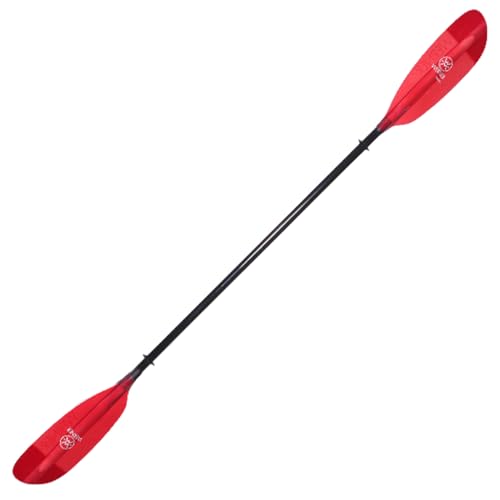
Werner Camano 220 cm Straight Shaft Paddle
Best for: Touring paddlers who prefer straight shafts
- Shaft Type
- Straight Shaft (what this guide is about)
- Blade Material
- Fiberglass
- Shaft Material
- Carbon Fiberglass Blend
- Length
- 220 cm
- Pieces
- 2 Piece
- Blade Shape
- Dihedral
View on Amazon: Werner Camano 220 cm Straight Shaft Paddle Affiliate link
This is a two-piece fiberglass kayak paddle with a straight shaft. It weighs 761 grams and features a 650 cm² dihedral blade. The carbon fiberglass blend shaft offers a stiff flex for a stable stroke. You get adjustable ferrules for feather angles between 0 and 60 degrees. This setup suits touring and recreation paddlers who want a reliable low-angle design.
Pros
- Lightweight 761 gram construction
- Adjustable ferrule with 0-60 degree range
- Stiff flex dihedral fiberglass blade
- Carbon fiberglass blend shaft
Cons
- Straight shaft lacks the efficiency of a bent shaft design
- 26.75 oz weight is heavier than full carbon options
- Standard diameter shaft may not fit smaller hands
Good fit if
- You prefer a traditional straight shaft feel
- You need adjustable feather angles for different conditions
- You are touring or recreating in calm waters
Skip if
- You require a bent shaft for high-angle paddling
- You want the absolute lightest paddle available
- You have very small hands and need a small diameter shaft
Verdict: Werner Camano 220 Straight Shaft provides a solid fiberglass build for paddlers who value adjustability and a stable stroke. It fits touring enthusiasts who do not need the specialized mechanics of a bent shaft.

Werner Camano 2-Piece Bent Shaft Paddle
Best for: Touring and recreation with bent shaft preference
- Shaft Type
- Bent Shaft (what this guide is about)
- Blade Material
- Fiberglass
- Shaft Material
- Carbon fiberglass blend
- Length
- 240 cm
- Pieces
- 2
- Blade Shape
- Dihedral
View on Amazon: Werner Camano 2-Piece Bent Shaft Paddle Affiliate link
This is a two-piece bent shaft kayak paddle designed for touring and recreation. It features a fiberglass blade with a 650 cm² surface area and a carbon fiberglass blend shaft. The 240 cm length suits standard paddlers. The Smart-View ferrule allows 0° to 60° feather adjustments. Its lightweight build at 934 g supports efficient paddling.
Pros
- Bent shaft design optimizes wrist and forearm ergonomics.
- Fiberglass blade offers stiff flex and dihedral stability.
- Smart-View adjustable ferrule secures with a solid feel.
- Carbon fiberglass blend shaft balances strength and weight.
Cons
- Bent shaft requires adaptation if you prefer straight shafts.
- Fiberglass blade is heavier than full carbon options.
- Two-piece design adds a ferrule joint compared to one-piece models.
Good fit if
- You prefer bent shafts for reduced joint strain.
- You need a lightweight paddle for touring.
- You want adjustable feather angles for varying conditions.
Skip if
- You require a one-piece paddle for simplicity.
- You prefer straight shafts for your stroke.
- You need a full carbon blade for maximum lightness.
Verdict: Werner Camano 240 Bent Shaft is a practical touring paddle for paddlers who benefit from bent shaft ergonomics. Its fiberglass blade and adjustable ferrule provide a reliable balance of durability and control for recreational use.

Werner Sherpa 1-Piece Straight Shaft Paddle
Best for: Whitewater play boating and river running
- Shaft Type
- Straight Shaft (what this guide is about)
- Blade Material
- Fiberglass
- Shaft Material
- Fiberglass
- Length
- 197 cm
- Pieces
- 1
- Blade Shape
- Dihedral
View on Amazon: Werner Sherpa 1-Piece Straight Shaft Paddle Affiliate link
The Werner Sherpa is a one-piece fiberglass paddle built for whitewater river running. It features a straight shaft with a dihedral blade shape for stable forward paddling. The 197 cm length and 680 cm² blade surface area offer a mid-size fit for a wide range of users. Weighing 985 grams, it provides a lightweight option for play boating with a fixed R30 feather angle.
Pros
- One-piece fiberglass construction for durability and simplicity
- Dihedral blade shape ensures smooth, stable forward strokes
- Lightweight at 985 grams for easier handling
- Mid-size 680 cm² blade fits a wide range of users
- Fixed R30 feather angle optimized for play boating
Cons
- One-piece design limits portability and storage flexibility
- Straight shaft may not suit preferences for bent shaft efficiency
- Fixed ferrule prevents adjustable feather angles
Good fit if
- You prioritize a durable, one-piece build for river running
- You prefer a mid-size blade for stable forward paddling
- You need a lightweight fiberglass paddle for whitewater
Skip if
- You require a multi-piece paddle for easy transport
- You prefer a bent shaft for different stroke mechanics
- You want adjustable feather angles for varied conditions
Verdict: Werner Sherpa 197cm Straight Shaft is a solid choice for whitewater paddlers seeking a durable, lightweight one-piece paddle with stable dihedral blades. It suits those who value simplicity and fixed R30 feathering for play boating.

Z&J Sport Full Carbon 190 cm Bent Shaft Paddle
Best for: Whitewater paddlers seeking bent shaft comfort
- Shaft Type
- Bent Shaft (what this guide is about)
- Blade Material
- Carbon fiber
- Shaft Material
- Carbon fiber
- Length
- 190 cm
- Pieces
- 2
- Blade Size
- 20 x 48 cm, 720 cm²
View on Amazon: Z&J Sport Full Carbon 190 cm Bent Shaft Paddle Affiliate link
This Z&J Sport paddle features a bent shaft and full carbon fiber construction. Weighing 38.8 ounces, it offers an ultralight feel for whitewater and river running. The 20 by 48 cm blades provide 720 square centimeters of surface area. An aluminum alloy adjuster allows angle changes from 0 to 90 degrees. This design helps keep your wrists aligned and reduces joint fatigue during intense paddling sessions.
Pros
- Full carbon fiber shaft and blades for stiffness and light weight
- Bent shaft design minimizes wrist and joint discomfort
- Aluminum alloy adjuster allows 0-90 degree angle changes
- Reinforced blade edges and PMI foam core for durability
Cons
- Bent shaft may not suit all paddling styles
- Includes only the paddle without additional accessories
- Weight tolerance of plus or minus 1.7 ounces varies
Good fit if
- You paddle whitewater or river running
- You prefer a lightweight carbon fiber build
- You want adjustable shaft angles for comfort
Skip if
- You need a straight shaft paddle
- You require a fixed angle without adjustment
- You prefer a heavier, more rigid shaft
Verdict: Z&J Sport 190cm Bent Carbon Paddle is a specialized tool for whitewater paddlers who value joint comfort and ultralight performance. It fits those who actively seek bent shaft ergonomics and adjustable angles for river running.
Specifications side by side
| Spec | Werner Skagit FG 2-Piece Straight Shaft Paddle | Bending Branches BB Special Bent Shaft Wood Paddle | Werner Camano 220 cm Straight Shaft Paddle | Werner Camano 2-Piece Bent Shaft Paddle | Werner Sherpa 1-Piece Straight Shaft Paddle | Z&J Sport Full Carbon 190 cm Bent Shaft Paddle |
|---|---|---|---|---|---|---|
| Blade Material | Fiberglass-reinforced nylon | Hardwood | Fiberglass | Fiberglass | Fiberglass | Carbon fiber |
| Shaft Material | Carbon blend | Solid basswood | Carbon Fiberglass Blend | Carbon fiberglass blend | Fiberglass | Carbon fiber |
| Shaft Type | Straight | Bent shaft | Straight | Bent | Straight | Bent |
| Length | 240 cm | 100 centimeters | 220 cm | 240 cm | 197 cm | 190 cm |
| Pieces | 2 | not stated | 2 Piece | 2 | 1 | 2 |
| Blade Shape | Dihedral | not stated | Dihedral | Dihedral | Dihedral | not stated |
| Blade Size | 605 cm²; 49 x 15.6 cm | not stated | 650cm², 52 x 16.5cm | 650 cm², 52 x 16.5 cm | 680 cm²; 46 x 19.5 cm | 20 x 48 cm, 720 cm² |
| Weight | 953 g (33.75 oz) | not stated | 761g (26.75oz) | 934 g (29 oz) | 985 g (34.75 oz) | 38.8 +/-1.7 oz |
| Ferrule Type | Smart View Adjustable | not stated | Smart-View Adjustable | Smart-View adjustable, 0°-60° | Fixed, R30 feather angle | Aluminum alloy adjuster, 0-90 degree |
| Use | not stated | Recreational canoeing | Touring & Recreation | Touring, recreation | Whitewater | Whitewater, river running, creeking |
| Color | Yellow | Wood | Trans. Red | Gradient: Citrus | Amber | not stated |
| Water Type | not stated | Rivers | not stated | not stated | not stated | not stated |
| Included Accessories | Paddle | Paddle | Paddle | Paddle | Paddle | Paddle |
| Dimensions | 52 × 8 × 3 inches | 100 × 100 × 50 centimeters | 47 × 8 × 4 inches | 46 × 8 × 3 inches | 79 × 13 × 3 inches | not stated |
| Size | 240 cm (Standard Shaft Diameter) | 52" | 220 cm (Standard Shaft Diameter) | 240 cm (Standard Shaft Diameter) | 197 cm (Standard Shaft Diameter-R30 Feather Angle) | 190cm |
| Model | SG_2 | P BB 50 | CA_2_F11_220_RED | CA_2_F31_240_4240_RA | Werner | not stated |
Frequently asked questions
Does a bent shaft improve my stroke efficiency?
Yes, the angled blade matches your natural stroke arc. This design improves power transfer and reduces wrist strain during long paddles. Werner offers bent shaft models like the Camano 240 for touring. These paddles help maintain a consistent angle as you rotate your torso, making each pull more effective.
Which shaft type is better for whitewater kayaking?
Both types work, but bent shafts offer joint comfort. The Z&J Sport 190cm Bent Carbon Paddle targets whitewater paddlers seeking ergonomic benefits. Straight shafts like the Werner Sherpa 197cm provide stability for play boating. You choose based on whether you prioritize joint relief or simple, fixed-feather control.
How does shaft type affect wrist comfort?
Bent shafts reduce strain by aligning the blade with your stroke. This angle minimizes awkward wrist twisting on each pull. Straight shafts require you to adjust your wrist angle for each side. Werner’s Skagit FG straight shaft simplifies mechanics but may demand more wrist adjustment over time.
Can I use a straight shaft for touring?
Absolutely. Straight shafts provide a stable, smooth stroke ideal for touring. The Werner Camano 220 cm Straight Shaft offers a solid fiberglass build for this purpose. It fits paddlers who prefer adjustability without specialized bent shaft mechanics. You get consistent power transfer through a uniform shaft diameter.
Do bent shafts require a specific feather angle?
Bent shafts often feature adjustable ferrules for feather angle control. The Werner Camano 2-Piece Bent Shaft includes an adjustable ferrule for reliable control. This allows you to set the blade angle to match your preference. You can fine-tune the setup for recreation or touring conditions.
Is a straight shaft simpler to learn?
Yes, straight shafts simplify stroke mechanics for beginners. You do not need to adjust your wrist angle for each side. The Werner Skagit FG 240 cm is a practical entry-level option. Its standard shaft diameter offers a consistent feel, making it easier to master basic forward paddling.
Which shaft type is lighter for long trips?
Material choice impacts weight more than shaft shape. The Werner Camano 220 cm Straight Shaft weighs 1.68 pounds. The Z&J Sport 190cm Bent Carbon Paddle uses carbon fiber for ultralight performance. You select based on weight goals, whether you prefer fiberglass straight shafts or carbon bent shafts.