Best AQUOS White Trolling Motors in 2026: 2 Picks
As an Amazon Associate we earn from qualifying purchases. Links on this page are affiliate links.
Finding the best AQUOS white trolling motors requires a close look at published specifications. We compared 2 models to help you match technical data to your boat. The top pick is the AQUOS Haswing 12V 55lb Transom Motor. It leads because its 26-inch shaft length offers the right reach for small vessels. This guide uses only the specs listed on each product page. You will find clear comparisons of thrust, mount type, and control methods. Use this information to decide which motor fits your fishing needs.
Quick picks
| # | Product | Best for | Price |
|---|---|---|---|
| 1 | AQUOS Haswing 12V 55lb Transom Motor Best overall | wireless control on small boats | Check price of AQUOS Haswing 12V 55lb Transom Motor on Amazon |
| 2 | AQUOS Haswing 80 lb 54-Inch Bow-Mount Motor Best budget | Heavy boats needing precise manual control | Check price of AQUOS Haswing 80 lb 54-Inch Bow-Mount Motor on Amazon |
The best fit for you
- You want wireless control on a small boat AQUOS Haswing 12V 55lb Transom Motor It includes a wireless remote and weighs just 26 pounds for portability.
- You need heavy thrust for a larger vessel AQUOS Haswing 80 lb 54-Inch Bow-Mount Motor It delivers 80 lb of thrust and features a 54-inch shaft for deeper water.
- You prefer a transom mount for easy setup AQUOS Haswing 12V 55lb Transom Motor It is designed as a transom trolling motor with a compact 26-inch size.
Our 2 picks

AQUOS Haswing 12V 55lb Transom Motor
Best for: wireless control on small boats
- Color
- White (what this guide is about)
- Thrust
- 55 lbs
- Shaft Length
- 26 in
- Mount Type
- Transom
- Control
- Wireless remote
- Voltage
- 12V
View on Amazon: AQUOS Haswing 12V 55lb Transom Motor Affiliate link
This white transom-mounted trolling motor delivers 55 lbs of thrust at 12V. It features a 26-inch cast aluminum shaft and a wireless remote with a 164-foot range. The 600W motor offers stepless speed control and tilts 0 to 85 degrees. Weighing 26 pounds, it is designed for portable use on kayaks or small boats where wireless convenience is key.
Pros
- Wireless remote with 164 ft range
- 55 lbs peak thrust
- 26-inch cast aluminum shaft
- 0-85 degree tilt adjustment
- USB-rechargeable remote
Cons
- Transom mount limits bow placement options
- 26-inch shaft may be short for deeper water
- Single motor configuration
Good fit if
- You prefer wireless control over foot pedals
- You need a lightweight motor for transport
- You fish in shallow to medium depths
Skip if
- You require bow mount stability
- You need more than 55 lbs of thrust
- You prefer wired remote connections
Verdict: AQUOS 26in Transom Trolling Motor suits anglers who prioritize wireless convenience and portability over bow-mount stability.
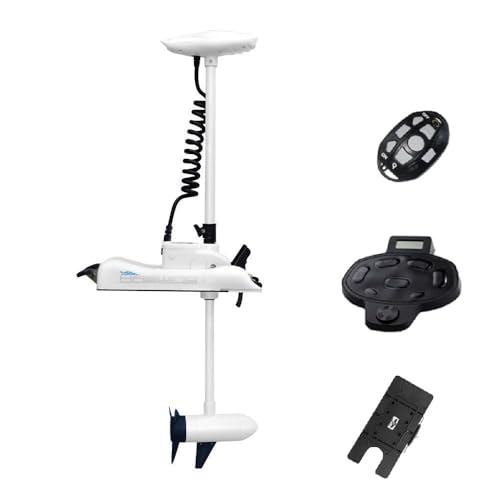
AQUOS Haswing 80 lb 54-Inch Bow-Mount Motor
Best for: Heavy boats needing precise manual control
- Color
- White (what this guide is about)
- Thrust
- 80 lbs
- Shaft Length
- 54 in
- Mount Type
- Bow mount
- Control
- Remote, foot pedal
- Voltage
- 24V
View on Amazon: AQUOS Haswing 80 lb 54-Inch Bow-Mount Motor Affiliate link
This white AQUOS Haswing bow mount trolling motor delivers 80 lb of thrust with a 24V system and a 54-inch shaft. You get both a wireless remote and a foot pedal for control. The unit features variable speed settings and cruise control. It is built for both fresh and saltwater use with corrosion-resistant components. This setup suits anglers needing precise maneuvering and hands-free operation on larger vessels.
Pros
- 80 lb thrust for heavy boats
- 24V voltage system for efficiency
- Wireless remote and foot pedal included
- Cruise control for steady speed
- Fresh and saltwater corrosion resistance
Cons
- No GPS spot-lock navigation
- Requires manual direction correction
- Limited to bow mount installation
Good fit if
- You need high thrust for larger boats
- You want both remote and foot control
- You fish in saltwater environments
Skip if
- You require GPS spot-lock features
- You prefer a transom mount
- You need a 12V system only
Verdict: AQUOS Haswing 80lb 54in Bow Mount offers robust 80 lb thrust and versatile control options for anglers who prioritize power and flexibility over automated navigation.
Specifications side by side
| Spec | AQUOS Haswing 12V 55lb Transom Motor | AQUOS Haswing 80 lb 54-Inch Bow-Mount Motor |
|---|---|---|
| Thrust | 55 lbs | 80 lbs |
| Shaft Length | 26 in | 54 in |
| Mount Type | Transom | Bow mount |
| Control | Wireless remote | Remote, foot pedal |
| Voltage | 12V | 24V |
| Speed Settings | One-way stepless | Variable speed |
| Water Type | Freshwater and saltwater | Freshwater, saltwater |
| Use | Boats | Boats |
| Propulsion | Trolling Motor | Trolling Motor |
| Color | White | White |
| Transducer | Wireless | Wireless |
| Dimensions | 37 × 18 × 10 inches | 12 × 66 × 17 inches |
| Weight | 26 pounds | not stated |
| Size | 26 inch | 54 inch |
| Model | Transom trolling motor | not stated |
How to choose the right trolling motor
-
Check the mount type
Decide between a transom or bow mount based on your boat’s design and your rowing style. The top pick is a transom motor, which attaches to the rear. This setup is ideal for smaller vessels where you want to keep the bow clear for casting or netting fish. The second option is a bow mount, which attaches to the front. This provides better stability and steering control for larger boats. Choose the mount that fits your hull shape and does not interfere with your seating or gear storage areas.
-
Verify shaft length
The shaft length must extend below the waterline to ensure efficient propulsion. The top pick features a 26-inch shaft, which is suitable for kayaks or small boats with low transoms. The second option has a 54-inch shaft, designed for deeper water or larger vessels. If the shaft is too short, the propeller will cavitate and lose power. If it is too long, it may drag on the bottom or interfere with rowing. Measure your transom or bow height to select the correct size for your specific boat model.
-
Assess thrust requirements
Thrust determines the motor’s pushing power. The second option delivers 80 lb of thrust, which is necessary for heavier boats or when fighting strong currents. The top pick offers 55 lb of thrust, which is sufficient for lightweight kayaks and calm waters. Higher thrust helps you move through wind or chop more effectively. Consider the total weight of your boat and gear. Select a motor with enough power to maintain speed without straining the battery or the motor itself during long trips.
-
Review control options
Both models include wireless remote controls for convenient operation. This allows you to adjust speed and direction from your seating position without reaching for the motor. The top pick emphasizes this wireless convenience for small boats. The second option also features a wireless remote, offering flexibility for larger setups. Check if the remote has a long range and clear signal. Ensure the control method matches your preference for manual adjustments versus automated navigation features available in other models.
-
Consider portability and weight
If you carry your boat frequently, weight matters. The top pick weighs 26 pounds, making it easy to lift and store. Its compact dimensions of 37 inches in length and 18 inches in width also aid in transport. The second option is heavier and larger, reflecting its robust construction for bow mounting. Check the physical dimensions of the motor to ensure it fits in your storage space. A lighter motor reduces fatigue when loading and unloading your kayak or small boat.
-
Match voltage to battery
The top pick operates on a 12V system, which is standard for most small boats and kayaks. Ensure your battery bank can supply this voltage for optimal performance. The second option is also designed for standard marine electrical systems. Using the correct voltage ensures the motor runs efficiently and extends battery life. Verify that your existing battery or planned battery setup matches the motor’s voltage requirement to avoid compatibility issues or reduced runtime on the water.
Frequently asked questions
What is the shaft length of the top pick?
The best overall model features a 26-inch shaft. This size suits smaller vessels or sit-on-top kayaks. It provides enough depth for efficient propulsion without dragging in shallow water. The compact 37-inch length also aids in storage and transport.
Does the top pick come with a wireless remote?
Yes, the top pick includes a wireless remote for control. This allows you to operate the motor from a seated position without reaching for a handle. The wireless transducer simplifies setup and reduces cable clutter on small boats.
How much does the best overall motor weigh?
The top-rated transom motor weighs 26 pounds. This light weight makes it easy to carry and mount on smaller kayaks or aluminum boats. You can lift and reposition it quickly without needing additional assistance or heavy lifting gear.
What thrust level does the bow mount option provide?
The second pick delivers 80 lb of thrust. This higher power output handles heavier boats or stronger currents more effectively. It is designed for anglers who need robust propulsion for larger vessels that require more driving force.
Is the second pick a transom or bow mount?
The second pick is a bow mount model. It attaches to the front of your boat for precise steering and stability. This configuration is ideal for larger vessels where bow control offers better maneuverability than a rear-mounted transom setup.
What is the shaft length of the bow mount motor?
The bow mount option features a 54-inch shaft. This longer length is necessary for deeper transoms or bows on larger boats. It ensures the propeller stays submerged for efficient thrust in deeper water conditions.
Does the bow mount model include wireless control?
Yes, the bow mount model includes a wireless remote. This feature provides flexible control options for the operator. You can adjust speed and direction without being tethered to the motor handle, enhancing convenience during long fishing trips.
What voltage do these AQUOS motors use?
The transom motor explicitly uses 12V power. This standard voltage is common for small to medium boats. It connects to a standard 12V battery, which is typical for kayaks and small fishing vessels, ensuring compatibility with most marine electrical systems.