AQUA Bound vs Wilderness Systems Kayak Paddles: Which Brand Fits You?
As an Amazon Associate we earn from qualifying purchases. Links on this page are affiliate links.
When you compare AQUA Bound vs wilderness systems kayak paddle options, you are weighing two distinct approaches to touring and recreation. Both brands target flatwater and light current paddling with adjustable features. The main difference lies in construction. The Aqua Bound Sting Ray uses a full carbon shaft with nylon blades. The Wilderness Systems Pungo combines a fiberglass composite blade with a mixed-material shaft. This choice affects weight, stiffness, and cost efficiency for your next outing.
Key differences
| Aspect | Aqua Bound Sting Ray Carbon 220 cm Paddle | Wilderness Systems Pungo Glass Adjustable Paddle |
|---|---|---|
| Shaft Material | 100% carbon fiber | 50% carbon/50% fiberglass |
| Blade Material | Reinforced nylon | Fiberglass composite |
| Blade Shape | Dihedral | not listed |
| Length Range | 220 cm (fixed) | 220-240 cm (adjustable) |
| Ferrule System | Versa-Lok, infinite feathering | Adjustable |
Which one should you choose?
Choose Aqua Bound Sting Ray Carbon 220 cm Paddle if
- You want the lightest swing weight to reduce fatigue on long tours.
- You prefer a fixed-length paddle for consistent stroke mechanics.
- You need dihedral blade design for stable, flutter-free forward strokes.
Choose Wilderness Systems Pungo Glass Adjustable Paddle if
- You need a paddle that adjusts from 220 cm to 240 cm.
- You prefer a fiberglass composite blade for durability and impact resistance.
- You share a paddle between kayaks of different widths.
Verdict: Choose the Aqua Bound Sting Ray if you prioritize a lightweight carbon shaft and precise, infinite feathering adjustments. Pick the Wilderness Systems Pungo if you need adjustable length flexibility and a durable fiberglass blade construction. Both serve recreation and touring well, so your decision depends on your preference for shaft stiffness versus length adaptability.
AQUA Bound vs Wilderness Systems Comparison
Shaft construction
The shaft material defines the feel and weight of your paddle stroke. The AQUA Bound Sting Ray Carbon uses a 100% carbon fiber shaft. This material reduces swing weight significantly, which helps lower fatigue during long touring sessions or fishing trips. The Wilderness Systems Pungo Glass employs a composite shaft made of 50% carbon and 50% fiberglass. This blend offers a different balance, prioritizing durability and a moderate flex profile. If you prefer a lighter, stiffer response for efficient power transfer, the all-carbon Sting Ray has a clear advantage. If you want a slightly more forgiving and robust shaft, the Pungo Glass is the better choice.
Blade material
Blade composition affects durability and water catch. The Sting Ray features reinforced nylon dihedral blades. Nylon is known for its toughness and resistance to impact damage, making it suitable for frequent use near rocks or docks. The dihedral shape helps reduce flutter for a smoother stroke. The Pungo Glass uses fiberglass composite blades. Fiberglass provides a solid, durable surface that handles recreational use well. While both materials are built for touring and recreation, nylon often offers a slight edge in impact resistance compared to standard fiberglass composites. Your choice depends on whether you prioritize the specific flex of fiberglass or the ruggedness of reinforced nylon.
Adjustability
Both paddles offer adjustable lengths to fit different kayak widths and paddler preferences. The AQUA Bound Sting Ray features a Versa-Lok ferrule system that allows for infinite feathering options and simple length adjustments. This gives you precise control over your setup. The Wilderness Systems Pungo Glass is adjustable from a base length of 220 cm up to 240 cm. This expandable range is useful if you need to accommodate different kayaks or wind conditions. The Sting Ray offers more granular control over feathering angles, while the Pungo provides a broad length range. For precise customization, the Sting Ray holds the edge.
Portability
How you store and transport your gear matters for car tops and small trunks. The AQUA Bound Sting Ray is designed as a two-piece breakdown paddle. It separates into two lightweight sections, making it easy to pack for travel or fit into tight storage spaces without sacrificing on-water performance. The Wilderness Systems Pungo Glass is listed with a total length of 95 inches in its specs, which suggests a fixed or less easily breakdown-friendly design compared to the dedicated two-piece Sting Ray. If you frequently travel or have limited storage, the two-piece design of the Sting Ray offers a practical advantage for portability.
Intended use
Both brands target similar environments, but with slight nuances. The Sting Ray is explicitly built for flatwater touring, recreation, and fishing outings. Its design emphasizes comfort and efficiency for these specific activities. The Pungo Glass is designed for recreation and touring, and is specifically noted to work well with Wilderness Systems Punto kayaks and other Recreation models. While both are suitable for lakes, rivers, and calm coastal waters, the Sting Ray’s marketing emphasizes versatility across fishing and touring. The Pungo is tightly integrated with specific kayak lines. For general touring and fishing, both are solid, but the Sting Ray’s broader fishing focus gives it a slight practical edge for mixed use.
Which paddle suits your style
Tourers wanting minimal fatigue
The 100% carbon fiber shaft reduces swing weight significantly. This lower mass decreases fatigue during long paddling sessions. The dihedral blades provide stable forward strokes with minimal flutter. You gain responsive power transfer for efficient touring on flatwater or light current conditions.
Paddlers needing size flexibility
This paddle adjusts from 220 cm to 240 cm. You can expand the length to match wider kayaks or windier conditions. The fiberglass composite blades offer durability without excessive stiffness. The 50% carbon shaft balances weight and cost, making it a versatile choice for variable water.
Travelers seeking compact storage
The two-piece breakdown design splits into lightweight sections. This format simplifies transport and storage in tight spaces. You avoid the bulk of a fixed-length shaft. The Versa-Lok ferrule ensures secure connections while allowing infinite feathering adjustments to suit your personal preference and kayak width.
The products compared

Aqua Bound Sting Ray Carbon 220 cm Paddle
Best for: Touring and fishing with adjustable feathering needs
- Blade Material
- Reinforced nylon
- Shaft Material
- Carbon fiber
- Length
- 220 cm
- Pieces
- 2
- Blade Shape
- Dihedral
- Ferrule Type
- Versa-Lok, infinite feathering
View on Amazon: Aqua Bound Sting Ray Carbon 220 cm Paddle Affiliate link
This paddle features a 100% carbon fiber shaft and reinforced nylon dihedral blades. The 220 cm length and two-piece design aid transport. The Versa-Lok ferrule allows infinite feathering and length adjustment. It suits flatwater touring, recreation, and fishing. You get responsive strength and reduced swing weight for extended outings.
Pros
- 100% carbon fiber shaft reduces swing weight and fatigue
- Reinforced nylon dihedral blades minimize flutter for stable strokes
- Versa-Lok ferrule provides infinite feathering and length adjustment
- Two-piece design simplifies storage and transport
Cons
- Fixed 220 cm length may not suit all kayak widths
- Reinforced nylon blades are less rigid than carbon options
- No included accessories beyond the paddle itself
Good fit if
- You need a lightweight carbon shaft for long tours
- You want adjustable feathering for changing wind conditions
- You prefer a two-piece design for easy transport
Skip if
- You require a fixed feathering angle only
- You prefer a one-piece paddle for simplicity
- You need a blade material more rigid than nylon
Verdict: Aqua Bound Sting Ray Carbon 220 cm delivers a lightweight carbon shaft and adjustable ferrule for touring and fishing. It fits paddlers who prioritize reduced fatigue and customizable stroke settings.
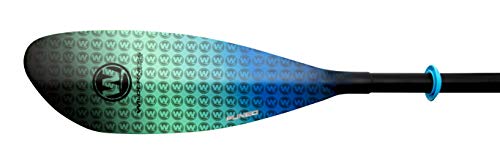
Wilderness Systems Pungo Glass Adjustable Paddle
Best for: Recreation and touring kayaks
- Blade Material
- Fiberglass composite
- Shaft Material
- 50% carbon/50% fiberglass
- Length
- 220-240 cm
- Use
- Recreation, touring
- Ferrule Type
- Adjustable
- Included Accessories
- Paddle
View on Amazon: Wilderness Systems Pungo Glass Adjustable Paddle Affiliate link
The Wilderness Systems Pungo is a fiberglass-blade paddle with a 50/50 carbon-fiberglass shaft. Its length adjusts from 220cm to 240cm, allowing you to fine-tune the reach for your kayak size. This design targets recreation and touring paddlers who want to reduce fatigue. The composite blade offers durability without the weight of full carbon. It is a practical option for those who prefer an adjustable fit over a fixed-length shaft.
Pros
- Adjustable length from 220cm to 240cm
- 50% carbon and 50% fiberglass shaft
- Durable fiberglass composite blade
- Designed for recreation and touring
Cons
- Heavier than full carbon options
- Blade is fiberglass, not carbon
- Limited to two length settings
Good fit if
- You need an adjustable paddle length
- You paddle recreation or touring kayaks
- You want a durable fiberglass blade
Skip if
- You require a full carbon shaft
- You prefer a fixed-length paddle
- You need multiple length settings
Verdict: Wilderness Systems Pungo 220-240cm suits paddlers who value adjustability and durability over the lightest possible weight. It is a solid choice for recreation and touring kayaks where a 50/50 shaft provides a balanced feel.
Specifications side by side
| Spec | Aqua Bound Sting Ray Carbon 220 cm Paddle | Wilderness Systems Pungo Glass Adjustable Paddle |
|---|---|---|
| Blade Material | Reinforced nylon | Fiberglass composite |
| Shaft Material | Carbon fiber | 50% carbon/50% fiberglass |
| Length | 220 cm | 220-240 cm |
| Pieces | 2 | not stated |
| Blade Shape | Dihedral | not stated |
| Ferrule Type | Versa-Lok, infinite feathering | not stated |
| Use | Flatwater touring, recreation, fishing | Recreation, touring |
| Color | Black | Galaxy |
| Included Accessories | Paddle | Paddle |
| Dimensions | 52 × 8.5 × 3 inches | 95 × 8 × 1 inches |
| Size | 220 cm | 220-240 cm |
| Model | SRA-VC2CB | 8070206 |
Frequently asked questions
Is the Aqua Bound Sting Ray paddle good for fishing?
Yes, this paddle is designed for fishing and touring. It features a 220 cm length and a lightweight carbon shaft. These specs help reduce fatigue during long sessions on the water. The adjustable ferrule allows you to change feathering angles to suit your stroke style.
How wide are the blades on the Aqua Bound Sting Ray?
The blades on the Aqua Bound Sting Ray are 8.5 inches wide. This width, combined with a 3-inch height, provides a solid surface area for water catch. The dihedral blade shape helps stabilize your forward stroke by reducing flutter.
Does the Wilderness Systems Pungo paddle adjust in length?
Yes, the Wilderness Systems Pungo Glass Adjustable Paddle offers a length range of 220 to 240 cm. This adjustability lets you fine-tune the paddle to your specific height and paddling style. The adjustable ferrule mechanism allows for quick changes without tools.
What material is used for the Wilderness Systems Pungo blades?
The blades on the Wilderness Systems Pungo are made from fiberglass. This material offers a balance of durability and flexibility. It suits recreation and touring kayaks where you want a sturdy paddle that can handle regular use without being overly heavy.
Which paddle is lighter for long distance touring?
The Aqua Bound Sting Ray Carbon is lighter due to its 100% carbon fiber shaft. This construction significantly reduces swing weight compared to glass or aluminum options. Lower mass helps decrease arm and shoulder fatigue during extended paddling trips.
Can I adjust the feathering angle on both paddles?
Yes, both paddles feature adjustable ferrules. The Aqua Bound uses a Posi-Lok system for secure locking. The Wilderness Systems Pungo has an adjustable ferrule as well. This allows you to customize the blade angle to match your preferred stroke technique.
What is the shaft shape on the Wilderness Systems Pungo?
The Wilderness Systems Pungo features a 50/50 shaft design. This means the shaft is round on one side and flat on the other. This balanced feel helps many paddlers maintain a consistent grip and stroke rhythm during recreational or touring outings.
Is the Aqua Bound Sting Ray paddle two-piece?
Yes, the Aqua Bound Sting Ray Carbon is a two-piece paddle. This design makes it easier to pack for travel or store in a kayak cockpit. The 220 cm length is ideal for most average-height paddlers in touring and fishing scenarios.